How do you identify non-woven fabric
Jun 24, 2024
Nonwovens are special fabrics whose notable feature is that the fibers are bonded by a process other than traditional weaving or knitting. Here is a summary of how to identify nonwovens:
Appearance and Texture:
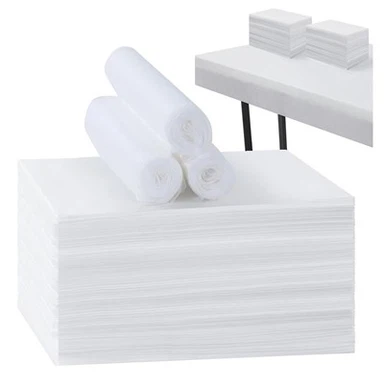
Appearance: Nonwovens often have a flat, felt-like appearance, similar to paper, felt, or tightly pressed fabrics.
Touch: Unlike woven or knitted fabrics, nonwovens may have a soft or stiff touch, but generally lack a distinct interwoven texture.
Fiber Arrangement:
Randomness: Fibers are usually randomly arranged, in contrast to the regular pattern of woven fabrics.
Uniformity: Fibers are more evenly distributed throughout the nonwoven.
Edge Characteristics:
No Abrasion: Edges are less likely to fray when cut, unlike the unraveling that can occur with woven fabrics.

Strength and Stretch:
Strength: Depends on the bonding method, but generally has less tensile strength than woven fabrics.
Stretch: Limited stretch compared to knitted fabrics.
Bonding Technology:
Thermal Bonding: Partially melts without completely burning, evident when exposed to heat.
Chemical Bonding: It may have a slight chemical odor.
Applications and uses:
Disposable products: Common applications such as medical masks, wipes, and diapers.
Industrial applications: Geotextiles, filtration products, and insulation materials.
Water absorption:
Hydrophilic or hydrophobic: Can be designed to absorb or repel water, which can be determined by a water drop test.
Burning test:
Burning characteristics: Usually melts and shrinks when burning, producing a plastic-like odor (if it is a synthetic fiber).